
Many people use the terms financial independence and financial freedom interchangeably. While they are closely related, they are not the same, and understanding the difference can completely change how you approach wealth building.
If you don’t clearly define these concepts, you risk setting vague financial goals or measuring your progress incorrectly.
At its core, your journey to wealth follows a structured path. If you’re just starting out, begin with Financial Freedom for Beginners: Where to Start to build your foundation. From there, everything connects through a broader system like your Financial Freedom Roadmap, which shows how income, saving, investing, and discipline work together.
Understanding financial independence vs financial freedom gives you clarity on where you are and what to aim for next.
What Is Financial Independence?
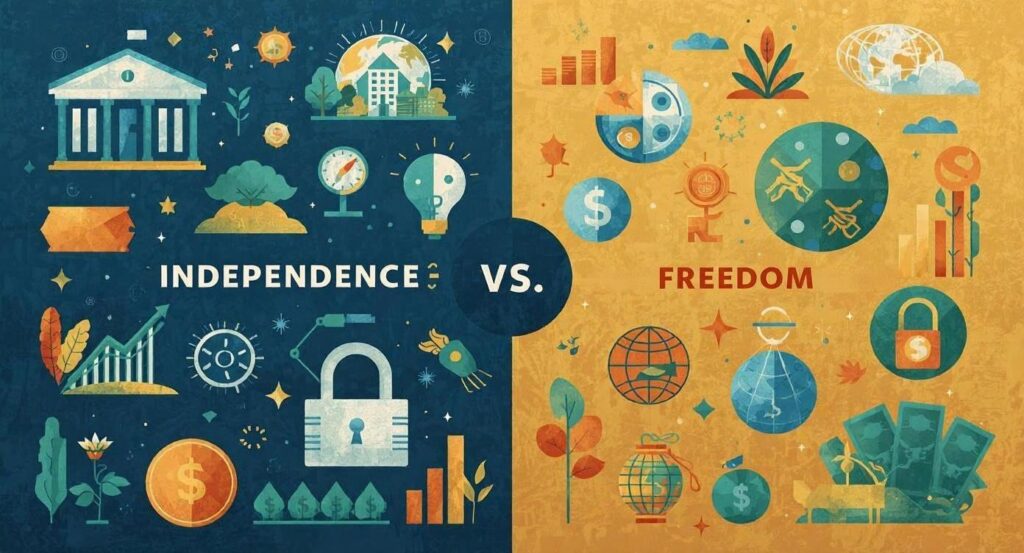
Financial independence means you have enough income from investments or assets to cover your basic living expenses.
At this stage:
- You no longer depend on a job to survive
- Your essential needs are covered by passive income
- You have financial security and stability
This does not necessarily mean luxury or unlimited spending.
It simply means you are no longer financially dependent on active income.
Key Characteristics of Financial Independence
- Consistent passive income
- Controlled lifestyle expenses
- Strong savings and investment habits
- Reduced financial stress
Financial independence is often considered the first major milestone in wealth building.
To calculate exactly what this looks like for you, read How Much Money Do You Need for Financial Freedom, where you’ll learn how to determine your personal independence number.
What Is Financial Freedom?
Financial freedom goes beyond independence.
It means you have enough wealth not just to survive, but to live life entirely on your terms.
At this stage:
- Your income exceeds your lifestyle needs
- You are not restricted by financial limitations
- You have full control over your time and choices
Financial freedom is about abundance and flexibility, not just stability.
Key Characteristics of Financial Freedom
- Significant surplus income
- Multiple passive income streams
- Time freedom and lifestyle flexibility
- Ability to make choices without financial constraints
This is the ultimate goal of personal finance.
If you want to map out how to reach this level, read How to Create a Personal Financial Freedom Plan, where everything is broken into actionable steps.
Financial Independence vs Financial Freedom: The Core Difference
The simplest way to understand financial independence vs financial freedom is this:
- Financial independence = covering your needs
- Financial freedom = funding your desired lifestyle
Independence is about security.
Freedom is about choice.
Independence removes financial stress.
Freedom removes financial limitations.
Both stages are essential, but they are not the same, and this is why understanding financial independence vs financial freedom is critical
A Simple Example
Let’s break it down clearly:
- Person A earns $2,500/month from investments and spends $2,500
→ Financially independent - Person B earns $10,000/month from investments and spends $3,000
→ Financially free
The difference is surplus income.
Financial freedom creates options, flexibility, and control.
Financial Independence vs Financial Freedom Summary
In summary, financial independence vs financial freedom comes down to stability versus lifestyle. Financial independence ensures your basic needs are covered, while financial freedom gives you the ability to live life on your own terms without financial limitations.
Where These Concepts Fit in the Financial Freedom Pyramid
The financial freedom pyramid helps explain how these stages connect.
Financial independence sits near the top.
Financial freedom is the final stage.
Before reaching these levels, you must pass through:
- Financial stability
- Financial security
- Financial growth
If you haven’t seen this structure yet, read The Financial Freedom Pyramid Explained (Step-by-Step Guide) to understand how each stage builds on the next.
This prevents the most common mistake: trying to skip steps.
How to Achieve Financial Independence
Reaching financial independence is a process built on discipline and consistency.
1. Control Your Expenses
You must consistently spend less than you earn.
If this is a struggle, start with How to Stop Living Paycheck to Paycheck (Complete Guide) to fix your cash flow.
2. Build a Strong Savings Rate
Your savings rate determines how fast you progress.
Many financially independent individuals save 30%–60% of their income.
3. Invest Consistently
Saving alone is not enough, you must invest.
Understanding The Power of Compound Interest: How Money Grows Over Time will show you how consistent investing turns small contributions into long-term wealth.
4. Eliminate High-Interest Debt
Debt slows your progress and reduces your ability to invest.
Avoid common traps by reading 10 Money Mistakes That Destroy Wealth (And How to Avoid Them).
5. Increase Your Income
Higher income accelerates everything.
One of the fastest ways to grow is by building multiple streams of income.
Read How to Build Multiple Streams of Income for Financial Freedom to expand your earning capacity.
How to Achieve Financial Freedom
How to Achieve Financial Freedom
Once you reach independence, your focus shifts from stability to expansion.
1. Expand Passive Income Streams
Financial freedom is powered by income that doesn’t require your time.
This includes:
- Investments
- Online businesses
- Digital assets
Learn how to build these in How to Build Passive Income Streams.
2. Grow Your Investment Portfolio
Your investments should generate more income than your expenses.
This creates surplus wealth, the foundation of freedom.
3. Maintain Strong Financial Habits
Even at higher levels, habits still matter.
Read 10 Daily Habits for Financial Freedom That Build Long-Term Wealth to maintain consistency.
4. Design Your Ideal Lifestyle
Freedom is not just financial, it’s intentional.
Define:
- How you want to spend your time
- Where you want to live
- What kind of life you want
Without clarity, freedom becomes meaningless.
Why Most People Never Reach Financial Freedom

Many people reach stability, but never move beyond it.
Common reasons include:
- Lack of financial education
- Poor money habits
- Lifestyle inflation
- Fear of investing
- Inconsistent income growth
Avoiding these pitfalls is essential for long-term success.
4 Common Misconceptions About Financial Independence vs Financial Freedom
When discussing financial independence vs financial freedom, many people misunderstand what each stage truly represents. These misconceptions often lead to poor financial decisions and unrealistic expectations.
Misconception 1: Financial Independence Means You Are Rich
Financial independence does not mean extreme wealth. It simply means your income from investments covers your essential expenses.
You may still live a modest lifestyle while being financially independent.
Misconception 2: Financial Freedom Requires Millions
While wealth helps, financial freedom is more about lifestyle design than a specific number.
Someone with low expenses may achieve financial freedom with far less than someone with high spending habits.
Misconception 3: You Can Skip Financial Independence
One of the biggest mistakes in the financial independence vs financial freedom journey is trying to jump straight to freedom.
Without independence, your financial system lacks stability.
Misconception 4: Passive Income Requires No Effort
Many believe passive income is completely hands-off.
In reality, most passive income streams require:
- Initial effort
- Capital
- Maintenance
Understanding these realities helps you approach both independence and freedom with clarity and realistic expectations.
The Psychology Behind Financial Independence vs Financial Freedom
Success in the journey of financial independence vs financial freedom is not just about numbers, it is deeply psychological.
Your mindset determines whether you reach independence and whether you sustain freedom.
1) Delayed Gratification vs Instant Gratification
Financial independence requires choosing long-term gains over short-term pleasure.
For example:
- Investing instead of spending
- Saving instead of upgrading lifestyle
Those who master delayed gratification reach independence faster.
2) Identity and Money Habits
Your financial behavior is tied to identity.
If you see yourself as:
- A spender → you consume
- An investor → you build wealth
To succeed in financial independence vs financial freedom, you must shift your identity toward wealth-building behaviors.
3) Fear and Financial Decisions
Fear prevents many people from:
- Investing
- Starting businesses
- Taking calculated risks
This is why many remain stuck at financial stability and never reach independence.
4) Lifestyle Inflation Psychology
As income grows, the brain naturally justifies increased spending.
Without discipline:
- Income increases
- Expenses increase equally
- Wealth does not grow
This is one of the biggest psychological barriers between financial independence and financial freedom.
5) The Freedom Mindset Shift
At independence, the mindset must evolve.
You move from:
- “How do I survive?”
To: - “How do I design my life?”
This shift is what separates those who remain stable from those who achieve true financial freedom.
Financial Independence vs Financial Freedom: Which Should You Focus On?
You should focus on both, but in the right order.
- First → Financial independence
- Then → Financial freedom
Think of it this way:
- Freedom = expansion
- Independence = foundation
Trying to achieve freedom without independence often leads to financial instability.
Think of independence as the foundation.
Freedom is the expansion.
To develop the right mindset, read The Financial Freedom Mindset That Builds Wealth.
How Long Does It Take to Achieve Each?
The timeline depends on several factors:
- Income level
- Savings rate
- Investment returns
- Lifestyle choices
Financial independence can take:
10–20 years (on average)
Financial freedom may take longer, depending on lifestyle goals.
The key is consistency.
Mistakes People Make After Reaching Financial Independence
Reaching independence is a major milestone,but many people make critical mistakes at this stage that prevent them from achieving full financial freedom.
Understanding these mistakes is essential in the financial independence vs financial freedom journey.
Mistake 1: Stopping Wealth Building Too Early
Some individuals stop investing aggressively once they reach independence.
This limits growth and delays financial freedom.
Mistake 2: Increasing Lifestyle Too Quickly
Sudden lifestyle upgrades can:
- Increase expenses
- Reduce investment capacity
- Reverse financial progress
This is one of the fastest ways to lose independence.
Mistake 3: Relying on a Single Income Source
Even at independence, relying on one income stream creates risk.
Diversification is key to reaching true financial freedom.
Mistake 4: Ignoring Inflation
Many underestimate how inflation reduces purchasing power.
Without continued growth, independence can weaken over time.
Mistake 5: Lack of Clear Lifestyle Vision
Financial independence without direction leads to confusion.
You must define:
- What freedom looks like
- How you want to live
- What your ideal life is
Without this clarity, financial freedom cannot be fully realized.
Real-Life Example of Financial Independence vs Financial Freedom
To fully understand financial independence vs financial freedom, let’s look at a simplified real-world scenario.
Case Study: Two Different Financial Paths
Person A – Financial Independence
- Monthly passive income: $3,000
- Monthly expenses: $3,000
- Savings: Minimal surplus
This person has achieved financial independence.
They are stable, secure, and no longer dependent on a job, but their lifestyle is limited to their current income.
Person B – Financial Freedom
- Monthly passive income: $12,000
- Monthly expenses: $4,000
- Surplus: $8,000
This person has achieved financial freedom.
They can:
- Travel freely
- Invest aggressively
- Pursue passion projects
Key Takeaway
The difference between financial independence vs financial freedom is not just income, it is margin and flexibility.
Financial independence gives you security.
Financial freedom gives you options.
Frequently Asked Questions
What is the main difference between financial independence and financial freedom?
Financial independence covers basic expenses, while financial freedom allows for lifestyle flexibility and unlimited choices.
Can you have financial independence without financial freedom?
Yes. Independence does not guarantee excess wealth or lifestyle flexibility.
Which comes first?
Financial independence comes first. Financial freedom comes after.
Is financial freedom realistic?
Yes, but it requires long-term discipline, smart investing, and income growth.
Do you need a high income to achieve financial freedom?
Not necessarily. What matters most is your savings rate and investment strategy.
Final Thoughts
Understanding financial independence vs financial freedom gives you a clear framework for your financial journey.
These are not competing ideas, they are stages of the same process.
- Financial independence removes financial stress
- Financial freedom gives you full control over your life
By building strong habits, increasing income, and investing consistently, you move from survival → stability → independence → freedom.
If you want a practical, action-based next step, read The Financial Freedom Checklist (Step-by-Step Guide) to start implementing everything you’ve learned.