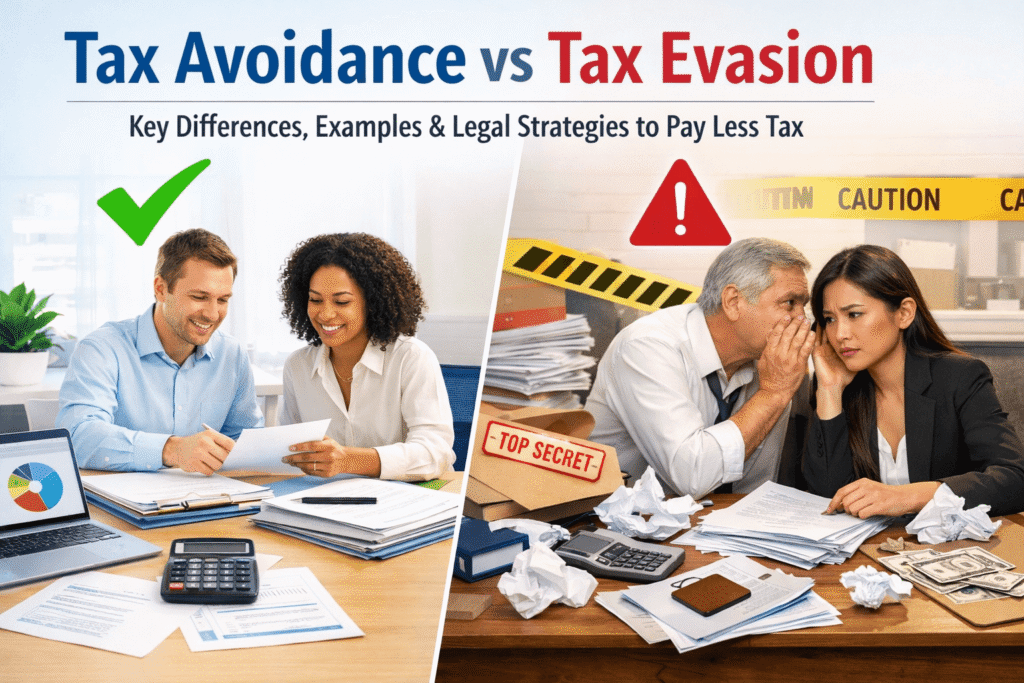
Tax evasion vs tax avoidance in different countries is one of the most important concepts to understand in today’s global economy. While taxes exist everywhere, how they are interpreted, enforced, and regulated varies significantly across jurisdictions.
What qualifies as legal tax avoidance in one country may be considered aggressive or even illegal in another. As more people earn across borders through remote work, online businesses, and international investments, understanding this distinction is critical for staying compliant and protecting your wealth.
If you’re new to this topic, it helps to first understand the fundamentals like Legal Ways to Reduce Taxable Income in 2026. It provides the foundation needed to navigate global tax systems effectively.
This guide breaks down how different countries approach taxation, the penalties involved, and how to reduce taxes legally worldwide without crossing into tax evasion.
What Tax Evasion vs Tax Avoidance in Different Countries Really Means
Understanding tax evasion vs tax avoidance in different countries starts with one universal principle: tax avoidance is legal when done within the law, while tax evasion is illegal when it involves hiding or misrepresenting information.
However, the complexity comes from how each country interprets and enforces these rules. What is considered acceptable tax planning in one jurisdiction may be challenged in another, especially when strategies go against the intent of the law.
At its core, the difference is simple:
- Tax avoidance is the legal use of strategies to reduce tax liability
- Tax evasion is the illegal act of hiding or misreporting income
However, when it comes to tax evasion vs tax avoidance in different countries, the line is not always clear. The distinction often depends on:
- Intent
- Transparency
- Compliance with local laws
Governments allow deductions and incentives, but once income is concealed or misrepresented, it becomes evasion. Master these, and you can reduce taxes legally worldwide while staying fully compliant.
How Tax Avoidance Laws Differ Across Countries
Even though tax avoidance is legal everywhere, how far you can go depends on the country.
1. United States
The US has one of the most detailed tax systems in the world. It allows a wide range of deductions and credits, but it also enforces strict reporting rules.
- Global income must be reported, even if earned abroad
- Offshore accounts must be disclosed
- Aggressive avoidance strategies are closely monitored
This means you can reduce taxes legally, but documentation and transparency are critical.
2. United Kingdom
The UK actively distinguishes between acceptable tax planning and aggressive avoidance.
- Legal tax planning is allowed
- Artificial schemes designed purely to avoid tax are challenged
- Anti-avoidance rules are strongly enforced
The focus here is not just legality, but whether the strategy aligns with the intent of the law.
3. Canada
Canada allows standard tax avoidance strategies but takes a strict approach to abuse.
- Legitimate deductions and credits are encouraged
- The General Anti-Avoidance Rule targets aggressive planning
- Clear reporting is essential
This creates a balanced system where normal planning is safe, but excessive manipulation is risky.
4. Australia
Australia has strong anti-avoidance laws similar to the UK.
- Legal tax planning is supported
- Schemes that exploit loopholes are investigated
- Penalties increase for deliberate avoidance
The emphasis is on fairness and preventing misuse of the system.
5. Developing Economies (General Trend)
In many developing countries, tax systems are still evolving.
- Fewer structured deductions and credits
- Enforcement may vary
- Informal income reporting is more common
These differences make tax evasion vs tax avoidance in different countries a critical topic for anyone with international income, therefore makes it mandatory to know the Tax Avoidance Strategies High Earners Use (Without Breaking the Law).
However, this does not reduce legal responsibility. In fact, lack of structure can increase the risk of unintentional non-compliance.
Tax Evasion: How Penalties Differ
Tax evasion is treated seriously everywhere, but penalties vary.
- Financial Penalties
Most countries impose fines that can range from a percentage of unpaid tax to several times the amount owed. - Interest Charges
Unpaid taxes often accumulate interest over time, increasing the total liability. - Legal Consequences
In severe cases, tax evasion can lead to criminal charges, including imprisonment. - 4. Reputation Damage
For business owners and professionals, legal issues can damage credibility and future opportunities.
Understanding tax evasion vs tax avoidance in different countries helps you avoid these costly consequences.
The key takeaway is simple: short-term gains from evasion are almost always outweighed by long-term consequences.
Common Global Mistakes That Lead to Evasion
Even when people try to stay compliant, certain mistakes are common across countries.
- Not Reporting Foreign Income
Many assume income earned abroad does not need to be declared. This is often incorrect. - Ignoring Offshore Accounts
Bank accounts in other countries usually require disclosure. - Misunderstanding Tax Residency Rules
Tax obligations often depend on where you are considered a resident, not just where you live. - Using Aggressive Schemes
Some strategies appear legal but are challenged by tax authorities due to their intent.
These mistakes highlight the importance of understanding both local and international rules.
How to Stay Compliant Globally
To navigate tax evasion vs tax avoidance in different countries, follow these principles:
1. Understand Your Tax Residency
Your tax obligations depend on where you are considered a resident.
Some countries tax worldwide income, while others only tax local income. Knowing your status is the first step.
2. Report All Income Transparently
Transparency is key to global tax compliance. Whether income comes from salary, investments, or foreign sources, it should be reported accurately.
Transparency reduces risk and keeps your strategy compliant.
3. Use Legal Structures Carefully
International structures such as offshore accounts or foreign businesses are not illegal.
The issue arises when they are used to hide income instead of manage it legally.
4. Follow Local and International Rules
Tax laws do not operate in isolation. If you earn globally, you may be subject to multiple systems.
Understanding how they interact is essential.
5. Work With Professionals
International tax planning can become complex quickly.
A qualified professional can help you:
- Navigate multiple jurisdictions
- Avoid double taxation
- Stay compliant while optimizing taxes
Experts help you comply with international tax laws and avoid costly mistakes.
Because staying complaint is a necessity, learning How to Implement a Year-Round Tax Planning System: Maximize Savings and Stay Compliant becomes a knowledge everyone must have.
How Tax Evasion vs Tax Avoidance in Different Countries Connects to Wealth Building
Understanding tax evasion vs tax avoidance in different countries is not just about compliance, it’s a major advantage in wealth building.
When you apply this knowledge effectively, you can:
- Reduce unnecessary tax exposure
- Structure income efficiently
- Protect assets globally
- Improve long-term financial outcomes
Over time, this leads to better financial outcomes and more control over your wealth.
FAQs
Is tax avoidance legal in all countries
Yes, as long as it follows the law and is properly reported.
Can tax avoidance become illegal
Yes, if it involves hiding income or misleading information.
Do I need to report foreign income
In many countries, yes. It depends on your tax residency.
Are offshore accounts illegal
No, but they must be disclosed and used transparently.
What is the biggest risk in global tax planning
Misunderstanding rules across different countries.
Final Thoughts
In a globalized world, tax knowledge must go beyond local rules. Understanding tax evasion vs tax avoidance in different countries gives you the clarity needed to stay compliant while optimizing your finances.
The goal is not to avoid taxes entirely, but to reduce taxes legally worldwide while staying within the law. When you approach taxes with strategy, transparency, and structure, you protect your wealth and position yourself for long-term growth.
To deepen your strategy, explore related guides like Is Tax Avoidance Ethical? How Far Can Smart Tax Planning Go Without Becoming Evasion and How to Stay Compliant with Tax Laws While Paying Less, which expand on building a sustainable, compliant tax system across borders.
Because ultimately, financial success isn’t just about how much you earn, it’s about how much you keep, protect, and grow across countries.