
“Passive income” is one of the most searched phrases in personal finance. Millions of people watch videos about it every day. The promise is clear: earn money while you sleep. Build something once. Collect income forever.
The passive income content problem embedded in this industry is something almost no creator will acknowledge openly.
I have spent a significant amount of time studying this space. And I want to say something that most people in this space will not say: the passive income content industry has a fundamental honesty problem.
Here is what I mean.
The Passive Income Content Problem Nobody Talks About
below are the four most important passive income content problem nobody talks about.
1. The Creator’s Passive Income Is You
This is the biggest passive income content problem if you think about this carefully.
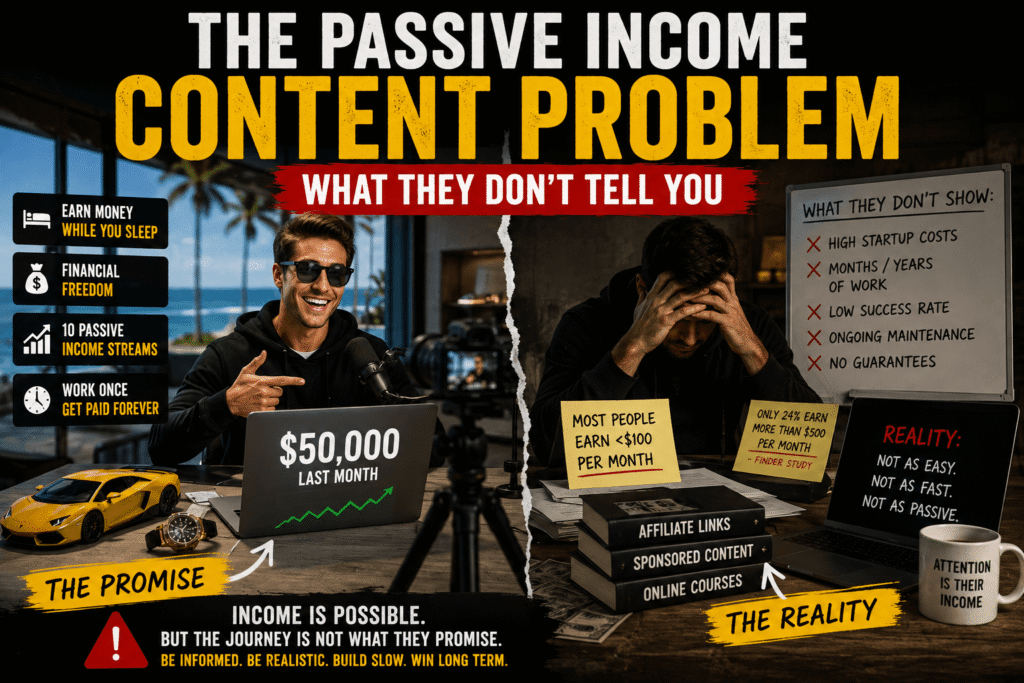
A YouTuber creates a video titled “10 Passive Income Streams That Made Me $50,000 Last Month.” That video earns advertising revenue every time someone watches it. The creator earns affiliate commissions every time someone clicks the links in the description. The creator earns course revenue every time someone buys the programme they recommend.
The creator’s passive income is the video itself. And the source of that income is your attention.
You are the product. Your attention is the asset. The “passive income” they are teaching you about is the exact system they are using on you.
This is not inherently wrong. It is a legitimate business model. But it creates a conflict of interest that almost no creator acknowledges openly.
The more people believe that passive income is easy and accessible, the more people watch passive income content. The more people watch, the more money the creator earns. The creator therefore has a financial incentive to make passive income sound simpler than it is.
2. The Results They Show Are Not Typical
Watch ten passive income videos carefully. Count how many times the creator shows their own income dashboard or earnings screenshot.
Now ask: is there any way to verify this?
In most cases, there is not. Income screenshots can be edited. They can show total revenue without showing the costs that reduce profit. They can show exceptional months without showing the average.
Research by the Federal Trade Commission (FTC) found that make-money-online claims are one of the most frequently investigated categories of consumer fraud. Not all passive income content is fraudulent. But the culture of showing large income numbers without context is widespread and misleading.
A study by Finder found that only 24 percent of people who tried to build passive income streams earned more than $500 per month from them. The majority earned nothing or less than $100.
The content you see is produced by the successful minority. The majority, who tried and failed, do not make videos about it.
3. Most “Passive” Income Is Not Actually Passive
Every legitimate income stream requires work. The question is when and how much.
Rental property income requires managing tenants, maintaining property, handling taxes, and dealing with vacancies. Dividend income requires capital to invest — capital that takes years to accumulate. Blogging income requires writing consistently, building an audience, and managing SEO. Selling digital products requires creating, marketing, and updating those products.
The word “passive” is used to describe income that does not require you to trade time for money in a one-to-one ratio. That is a real concept. But it does not mean effortless.
Most passive income streams require significant active effort upfront, and ongoing maintenance to sustain. The “passive” label hides that reality.
4. The Bar to Entry Is Higher Than Advertised
Here is what those content typically does not tell you and it’s not a passive income myth like others suggest.
To earn meaningful dividend income, you need substantial capital. At a 4 percent dividend yield, you need $250,000 invested to earn $10,000 per year. Most beginners do not have that capital.
To earn rental income, you need a down payment, good credit, and the ability to manage a property or pay a property manager. The barriers are significant.
To earn income from a YouTube channel or blog, you need to build an audience, typically thousands of subscribers or visitors, before earning meaningful revenue. That process takes months or years of consistent work.
None of these are impossible. But they are not the quick or easy paths that passive income content often implies.
What Legitimate Passive Income Building Looks Like
I do not want to dismiss the concept entirely. Earning passively is real but you need to have realistic expectations. It is worth building. But it deserves an honest description.
Building passive income is a long-term process. It starts with generating surplus income, earning more than you spend. That surplus gets invested over time. As the invested amount grows, so does the income it produces. This is the actual path.
The timeline for this process is years, not months. The compound interest calculator does the work, but only if you feed it consistently over time.
The most reliable passive income stream for most people is a diversified investment portfolio built steadily over a working career. It is not a side project that pays $10,000 a month within six months of starting.
Why This Matters
People who genuinely need financial improvement are the primary audience for passive income content. They are often struggling. They are looking for a realistic path out of financial stress.
When that audience is given inflated expectations and oversimplified instructions, they are set up to fail. When they fail, they often blame themselves rather than the content. They think they did something wrong.
The passive income content industry profits from aspiration. It is built on people wanting something better. And I believe it has a responsibility to be more honest about the effort, capital, and time required to achieve real results.
Frequently Asked Questions
What is the passive income content problem?
The passive income content problem refers to the way many creators make passive income seem easier, faster, and more profitable than it actually is, often because their own income depends on attracting viewers and selling products.
Is passive income really passive?
Not completely. Most passive income streams require significant upfront work, money, or ongoing maintenance, which is why many “passive” income ideas are not as effortless as they appear online.
Why do passive income videos show such high earnings?
Many creators highlight exceptional months, revenue instead of profit, or unverified income screenshots. This is a major part of the passive income content problem, as viewers rarely see average results or failure rates.
What is the most realistic passive income strategy?
For most people, the most reliable passive income comes from consistently investing in a diversified portfolio over many years rather than chasing quick online income streams.
Should beginners trust passive income content online?
Use passive income content as a source of ideas, not guarantees. Verify claims, calculate costs and timelines, and be cautious of creators who earn money primarily by promoting courses, affiliate products, or “make money online” systems.
Final Thoughts
I believe the passive income content industry is built on a structural misrepresentation. Not all creators lie. But the culture rewards optimistic claims and punishes realistic ones. Realistic content gets fewer views. Optimistic content goes viral.
The result is a body of content that consistently overpromises and underdelivers. And the people who pay the price are not the creators. They are the viewers who invest time, money, and hope into systems that were never as simple as advertised.
Passive income is worth pursuing. The content teaching it often is not worth watching.