Growing your money does not require speculative bets or stomach-churning volatility. Many people build substantial wealth by doing the opposite, prioritizing capital preservation, diversification, and patience over chasing the highest possible return. Learning how to grow money without taking big risks is especially valuable if you want steady progress, want to protect what you have, or are early in your investing journey.
This guide is specifically about managing risk while still growing. For the broader move from cash to investing, see How to Move From Saving to Wealth Building.
What It Means to Grow Money Without Taking Big Risks
Growing money without taking big risks means using diversified, lower-volatility investments and a long time horizon to increase wealth steadily while protecting your capital from large losses. It is not about avoiding investing, every investment carries some risk, but about balancing growth and protection so a single setback cannot derail your progress.
Common low-risk ways to grow money include high-yield savings accounts, certificates of deposit, government and high-quality bonds, broad-market index funds, dividend-paying investments, and retirement accounts.
For deploying small amounts into assets, see How to Turn Small Savings Into Wealth-Building Assets.
Why Risk Management Matters as Much as Returns
Most investors fixate on returns and overlook risk, but protecting capital is often what determines long-term success. A large loss is mathematically punishing, a 50% drop requires a 100% gain just to break even, and it can take years to recover from, delaying every financial goal.
Worse, big losses trigger emotional decisions that lock in damage. Managing risk keeps you in the game long enough for growth to compound.
Low-Risk vs High-Risk Investing
| Factor | Low-Risk Investing | High-Risk Investing |
|---|---|---|
| Primary goal | Capital preservation and steady growth | Maximum growth potential |
| Volatility | Lower | Higher |
| Potential returns | Moderate | Higher but uncertain |
| Risk of loss | Lower | Higher |
| Emotional stress | Lower | Higher |
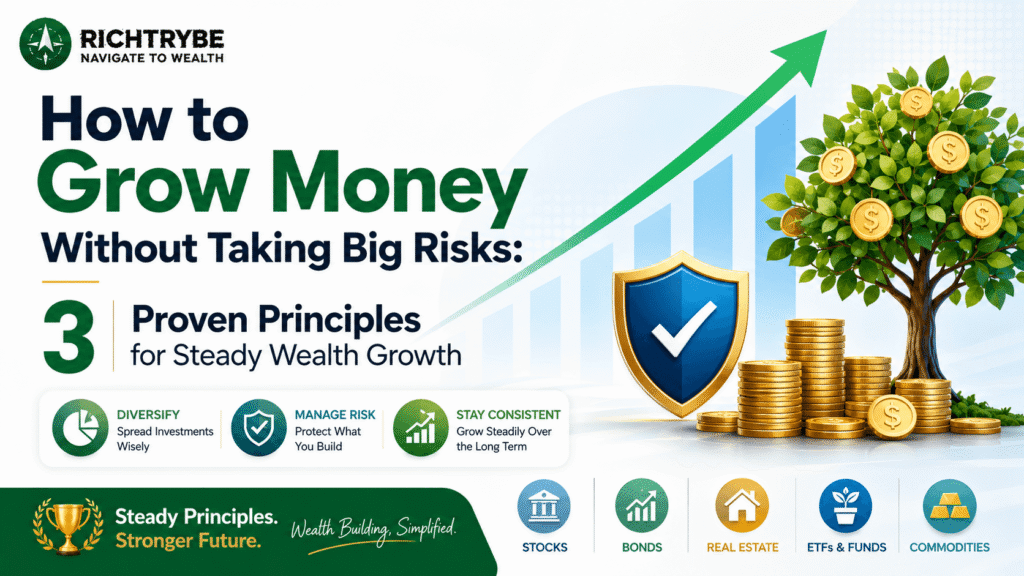
3 Principles to Grow Money Without Big Risks
If you want safe ways to grow your money, this 3 principles should be your go to.
Principle 1: Secure Your Foundation First
No investment strategy can compensate for a shaky financial base. An emergency fund and manageable debt are what let you stay invested through downturns instead of being forced to sell at the worst time.
Many investors lose money not because they picked bad investments, but because they lacked the stability to hold through a rough patch. Secure three to six months of expenses in accessible cash before reaching for growth.
Principle 2: Diversify Instead of Speculating
Diversification, spreading money across many investments rather than concentrating it, is one of the most effective ways to grow wealth while controlling risk.
According to the U.S. Securities and Exchange Commission, diversification and long-term investing can reduce risk and support steadier portfolio growth. Instead of asking “which investment will make me rich?”, ask “how do I build a mix that grows regardless of any single holding?” Lower-risk building blocks include:
- Broad-market index funds: exposure to hundreds or thousands of companies in one investment, reducing company-specific risk.
- ETFs: diversification and low costs with the flexibility to target broad markets or sectors.
- Bonds and fixed income: government and high-quality corporate bonds offer stability and predictable income with lower volatility than stocks.
- High-yield savings and CDs: for money needed sooner, these preserve capital while earning modest, dependable returns.
Principle 3: Let Time and Compounding Work
People overestimate what one year of investing can do and underestimate what twenty years can do. Compounding, when returns earn returns of their own, turns steady, unspectacular growth into substantial wealth given enough time.
Between an investor who constantly chases high-risk opportunities and one who invests consistently in diversified assets for decades, the second often comes out ahead, because consistency and compounding work together. The levers to grow money without taking big risks that matter most are simple: start early, invest regularly, reinvest earnings, and stay invested through market cycles.
Common Mistakes to Avoid
- Chasing high returns without understanding the risk: unusually high promised returns almost always carry hidden risk.
- Investing money needed soon: funds for near-term bills or emergencies should stay accessible and stable.
- Skipping diversification: leaning too heavily on one investment magnifies the damage if it falls.
- Trying to time the market: consistently predicting highs and lows is extremely difficult, even for professionals.
- Holding too much idle cash: excess cash beyond your buffer slowly loses purchasing power to inflation.
- Reacting emotionally: fear and excitement push people to sell low and buy high.
FAQs
What is the safest way to grow money?
High-yield savings accounts, certificates of deposit, government bonds, and diversified broad-market index funds and ETFs are commonly considered among the safer ways to grow money while limiting risk.
Can I grow wealth without taking big risks?
Yes. Many investors build substantial wealth through consistent investing, diversification, compounding, and a long time horizon rather than aggressive speculation.
What are the best low-risk investments for beginners?
Diversified index funds, ETFs, high-quality bonds, high-yield savings accounts, and CDs are popular lower-risk starting points because they spread risk and limit volatility.
Is keeping money in a savings account enough?
A savings account provides security but rarely outpaces inflation. Long-term growth usually requires investing, while savings remain ideal for emergencies and short-term needs.
How important is diversification?
It is one of the most effective tools for managing risk, because spreading money across many assets reduces the impact of any single investment performing poorly.
Final Thoughts
Growing money without taking big risks is not about finding a secret investment, it is about balancing growth with protection.
Secure your foundation, diversify rather than speculate, and let time and compounding do the heavy lifting. Consistent progress reliably beats aggressive gambling, because lasting wealth comes from how steadily you grow and protect what you already have.
For a complete roadmap that builds on these principles, read How to Build Wealth Step by Step: 10 Proven Strategies for Beginners.