
Many people use the terms income, wealth, and financial freedom interchangeably, but they represent very different stages of financial success. Understanding the difference between income wealth and financial freedom is essential if you want to build a stronger financial future and make better money decisions.
A high income can improve your lifestyle, but income alone does not guarantee wealth. Likewise, having wealth does not automatically mean you have achieved financial freedom. Each stage builds upon the previous one, yet each serves a distinct purpose in your financial journey.
Learning the relationship between income vs wealth vs financial freedom can help you move beyond simply earning money and begin building a financial life that provides security, flexibility, and long-term independence.
If you’re serious about creating lasting wealth, understanding these concepts is one of the most important financial lessons you can learn.
Before you begin, read How to Grow Money Without Taking Big Risks to learn how consistent investing and risk management contribute to long-term wealth creation.
What Is the Difference Between Income, Wealth and Financial Freedom?
The difference between income, wealth, and financial freedom is that income is the money you earn, wealth is the assets you own minus liabilities, and financial freedom is the ability to live from your assets and passive income without relying on active work. Income creates opportunity, wealth creates security, and financial freedom creates independence.
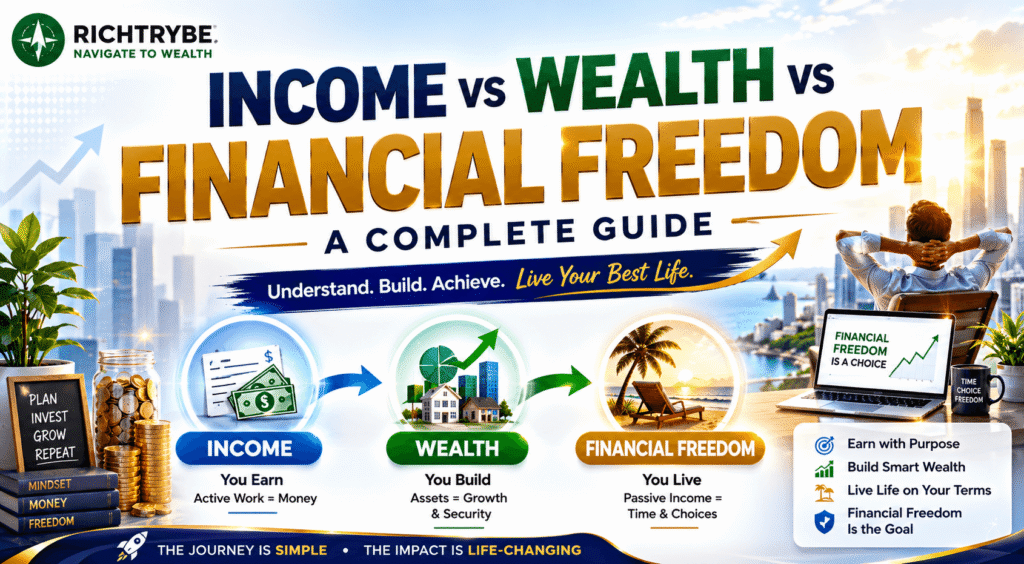
The difference between income wealth and financial freedom comes down to what each one represents in your financial life.
- Income is the money you earn from work, business activities, or investments.
- Wealth is the value of the assets you own after subtracting your liabilities.
- Financial Freedom is the ability to cover your lifestyle expenses without depending entirely on active work.
While these concepts are connected, they are not the same.
A person can earn a high income but have very little wealth if most of their earnings are spent. Similarly, a person can have substantial wealth but still lack financial freedom if their assets do not generate sufficient income.
In simple terms: Income creates opportunities. Wealth creates security. Financial freedom creates independence.
Income vs Wealth vs Financial Freedom
| Factor | Income | Wealth | Financial Freedom |
|---|---|---|---|
| Definition | Money earned | Assets owned minus liabilities | Ability to live without relying on active work |
| Source | Employment, business, investments | Asset ownership | Passive income and investments |
| Purpose | Fund current lifestyle | Build financial security | Create financial independence |
| Time Horizon | Short-term | Long-term | Lifetime |
| Dependency on Work | High | Moderate | Low |
| Financial Outcome | Cash Flow | Net Worth | Independence |
Why Understanding the Difference Matters
Many people spend their entire lives focused solely on increasing income.
While earning more money is important, income is only the starting point of financial success. Without converting income into assets and wealth, financial progress often remains tied to continued work.
When people misunderstand the relationship between income, wealth, and financial freedom:
- Higher earnings may lead to higher spending
- Net worth growth remains slow
- Financial dependence continues
- Retirement goals become harder to achieve
- Financial freedom remains out of reach
Understanding the difference between income, wealth, and financial freedom is only part of the equation. Building long-term financial success also requires financial education, disciplined investing, and informed decision-making. According to the FINRA Investor Education Foundation, improving financial knowledge can help individuals make better investment decisions and build stronger financial futures.
Income, Wealth, and Financial Freedom: Understanding the Progression
Learning the difference between income wealth and financial freedom is not simply about understanding financial definitions. It is about recognizing the progression that leads from earning money to achieving lasting financial independence.
Most people begin with income because income is the foundation that makes every other financial goal possible. However, financial success rarely stops there.
The journey generally follows three distinct stages:
- Generating Income
- Building Wealth
- Achieving Financial Freedom
Each stage of the income vs wealth vs financial freedom pyramid serves a different purpose and requires a different mindset.
For a deeper understanding of asset ownership, read How to Transition From Income to Assets.
Stage 1: Income Creates Financial Opportunity
Income is the starting point of nearly every financial journey.
Without income, it becomes difficult to save, invest, pay expenses, or acquire assets. Income provides the resources needed to build a stronger financial future.
Common sources of income include:
- Employment earnings
- Business income
- Freelance work
- Side hustles
- Investment income
However, income has an important limitation.
For most people, earned income depends on continued effort. If work stops, income often decreases or disappears entirely.
This is why income alone rarely creates financial independence.
Many people spend years increasing their earnings but never progress financially because their spending rises alongside their income.
Income creates opportunity, but opportunity must be converted into wealth.
Stage 2: Wealth Creates Financial Security
Wealth represents what you own rather than what you earn.
This is one of the most important income and wealth differences people need to understand.
Income flows into your life.
Wealth stays in your life.
Wealth is generally measured through net worth: Assets − Liabilities = Net Worth
Examples of wealth-building assets include:
- Stocks
- Index funds
- ETFs
- Real estate
- Businesses
- Retirement accounts
- Income-producing investments
Unlike income, wealth can continue growing even when you are not actively working.
This is why wealth creates financial security.
As wealth grows:
- Financial stress often decreases
- Emergency resilience improves
- Retirement becomes more achievable
- Future opportunities increase
- Dependence on debt decreases
Many people mistakenly believe high earners are automatically wealthy.
In reality, wealth depends far more on asset ownership and net worth growth than income alone.
For additional guidance, read The Best Wealth Building Assets for Beginners.
Stage 3: Financial Freedom Creates Independence
Financial freedom represents the point where your assets generate enough income to support your lifestyle without requiring full dependence on active work.
This is where the distinction between wealth vs financial freedom becomes important.
Wealth means owning valuable assets.
Financial freedom means those assets generate sufficient income to fund your life.
Sources of financial freedom may include:
- Dividend income
- Rental income
- Business income
- Investment withdrawals
- Royalties
- Other passive income streams
At this stage:
- Work becomes optional rather than mandatory
- Financial decisions become more flexible
- Time becomes more valuable than money
- Lifestyle choices expand
- Financial stress often decreases significantly
Financial freedom does not necessarily mean being extremely wealthy.
Instead, it means having enough assets and income-producing resources to support your desired lifestyle.
Common Misconceptions
Understanding what is the difference between income wealth and financial freedom becomes easier when you avoid these common misconceptions.
- Higher Income Automatically Creates Wealth: A larger income can help, but wealth is built through saving, investing, and asset ownership, not earnings alone.
- Wealth and Financial Freedom Are the Same: Wealth is what you own. Financial freedom is when those assets generate enough income to support your lifestyle.
- Financial Freedom Requires Millions of Dollars: The amount needed depends on your expenses, lifestyle, and financial goals, not a specific number.
- Investing Is Only for Wealthy People: Many people build wealth by investing small amounts consistently over long periods.
- Income Is More Important Than Assets: Income creates opportunities, but assets are often what drive long-term wealth and financial freedom.
Understanding these misconceptions helps clarify the relationship between income vs wealth vs financial freedom and highlights why building assets matters just as much as earning income.
How Understanding These Differences Changes Your Financial Future
Once you understand the relationship between income vs wealth vs financial freedom, your approach to money often begins to shift in meaningful ways.
Rather than focusing solely on earning more, you begin paying attention to how much of your income is being converted into assets and long-term wealth. You start viewing money as a tool for creating future opportunities instead of simply funding current expenses.
Over time:
- Income becomes a tool rather than the ultimate goal: You focus less on earning money and more on using it strategically.
- Asset ownership becomes more important: Building investments and income-producing assets becomes a priority.
- Net worth growth receives greater attention: Progress is measured by what you own, not just what you earn.
- Passive income becomes a priority: You begin creating income streams that do not rely entirely on active work.
- Long-term planning improves: Financial decisions become more intentional and future-focused.
- Financial independence becomes more realistic: You gain a clearer path toward achieving financial freedom.
Most importantly, understanding the difference between income wealth and financial freedom helps you build a financial system designed for long-term success. Instead of chasing a larger paycheck indefinitely, you begin focusing on the progression that truly creates lasting financial security: turning income into wealth and wealth into freedom.
FAQs
What is the difference between income wealth and financial freedom?
Income is money earned, wealth is the value of assets owned after liabilities are deducted, and financial freedom is the ability to live without depending entirely on active work.
Can someone have a high income but low wealth?
Yes. High earners may have little wealth if they spend most of their income and fail to acquire assets.
What is the difference between wealth and financial freedom?
Wealth refers to assets and net worth, while financial freedom refers to having enough income from those assets to support your lifestyle.
Why is income not the same as wealth?
Income is a flow of money, while wealth represents accumulated assets and ownership.
How does wealth lead to financial freedom?
Wealth can generate passive income through investments, businesses, and other assets, reducing dependence on active work.
Which should I focus on first?
Income typically comes first because it provides the resources needed to build wealth. Wealth then becomes the foundation for financial freedom.
Final Thoughts
Understanding the difference between income wealth and financial freedom can completely change the way you approach money.
Income is important because it provides the resources needed to improve your life and pursue financial goals. However, income alone rarely creates lasting financial success. Wealth is built when income is consistently converted into assets, investments, and ownership opportunities that increase your net worth over time.
Financial freedom represents the next stage of that journey. It occurs when the assets you have accumulated begin generating enough income to support your lifestyle and reduce your dependence on active work.
The progression is simple but powerful, Income creates opportunity. Wealth creates security. Financial freedom creates independence.
By focusing on all three stages, not just earning more money, you can build a financial future that provides greater flexibility, stronger financial security, and the freedom to make life decisions on your own terms.
For a practical roadmap to moving from earning money to building lasting wealth, read How to Build Wealth Step by Step: 10 Proven Strategies for Beginners.