
Every week, someone posts this advice online. A financial influencer. A motivational speaker. A LinkedIn thought leader. They all say the same thing: “Invest in yourself.” The “invest in yourself” financial advice has become one of the most repeated — and least examined — phrases in personal finance.
It sounds wise. It sounds deep. The problem is that it means almost nothing.
I have followed personal finance content for years. I have watched this phrase become the go-to answer for almost every financial question. Struggling with money? Invest in yourself. Want to build wealth? Invest in yourself. Feeling stuck at your job? Invest in yourself.
I think this advice has become one of the most overused and least useful phrases in financial education. Here is why.
The Invest in Yourself Financial Advice Phrase Has No Measurable Definition
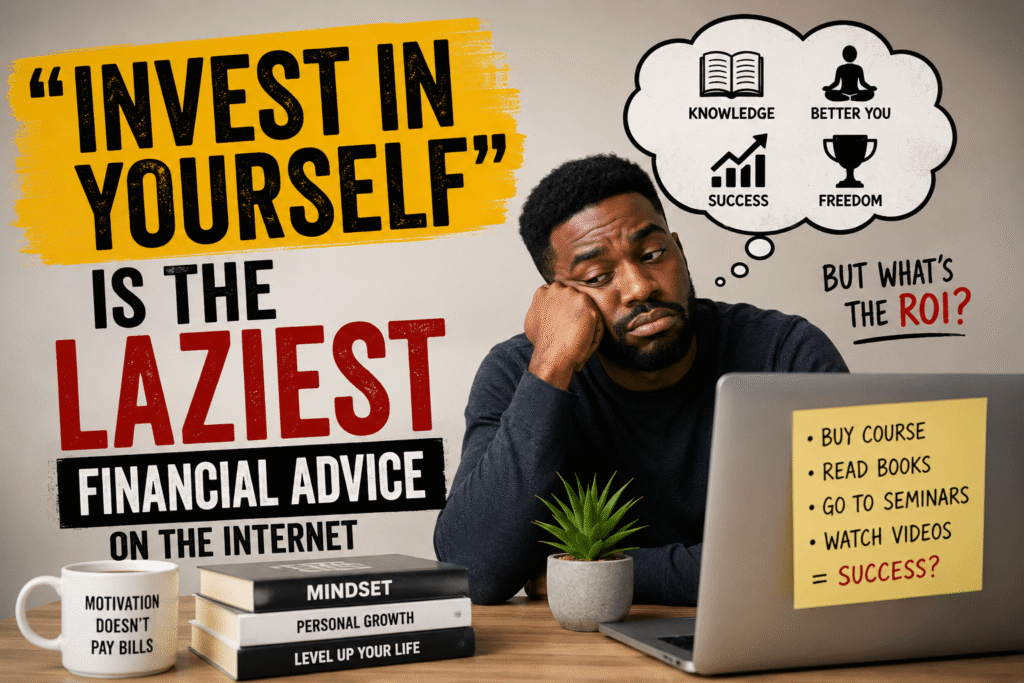
The first problem is simple: “invest in yourself” has no clear meaning.
When someone tells you to invest money in a stock, there is a process. You open an account. You research the asset. You place a specific amount. You track the return.
When someone tells you to invest in yourself, what do you do? You could buy a book. You could take an online course. You could join a gym. You could hire a therapist. You could buy expensive clothes. You could travel.
All of those things can be called “investing in yourself.” But they produce very different financial results. Some produce no financial return at all.
A phrase that can mean everything ends up meaning nothing. And advice that means nothing cannot help anyone.
It Became a Way to Avoid Specific Answers
I believe “invest in yourself” became popular because it sounds positive and avoids specifics. Specific advice is harder to give. It requires knowing your income. Your expenses. Your career situation. Your location.
Vague advice is easy to give and hard to criticise. If someone says “buy index funds” and the market drops, people get angry. But if someone says “invest in yourself” and you spend $2,000 on a course that does nothing, no one blames the advice.
This is not a coincidence. Vague advice protects the person giving it.
According to a 2022 survey by the National Endowment for Financial Education, 88 percent of Americans said they lacked confidence in their personal finance knowledge. Yet the most common financial advice they received was general motivation, not specific instruction. There is a gap between what people need and what they get. “Invest in yourself” sits directly in that gap.
Most “Self-Investment” Content Sells You Something
Here is a pattern I want you to notice.
When a course creator says “invest in yourself,” they often follow it with: “…and that’s why I created this programme.”
When a gym-brand ambassador says “invest in yourself,” they often sell you protein powder next.
When a productivity influencer says “invest in yourself,” they often sell you a planner or a workshop.
The phrase has become a marketing mechanism. It creates emotional permission to spend money. And many businesses have learned to attach it to their products.
This does not mean every course or book is bad. Many are genuinely useful. But you should recognise when “invest in yourself” is being used to help you or to sell you something.
There Are Cases Where It Is Good Advice, But They Need Specifics
I do not think all self-investment is worthless. I think the opposite. Specific self-investment is one of the most powerful financial tools available.
For example, a study by Georgetown University found that workers with professional certifications earned an average of 20 percent more than those without. That is a measurable return. That is a real investment.
Learning a specific skill with clear market demand, such as data analysis, software development, or digital marketing, can increase your income significantly. That income can fund your savings and investments. That is a direct financial return.
Improving your health through exercise reduces long-term medical costs. Research shows that physically active adults spend roughly 35 percent less on healthcare over their lifetime than sedentary adults.
These are not vague claims. They are specific, measurable returns on specific actions. The advice “invest in yourself” should be replaced by advice like this.
The Advice Often Distracts From the Basics
Here is the deeper problem. When people hear “invest in yourself,” they often delay the boring basics.
They buy courses instead of building an emergency fund. They attend paid workshops instead of opening a retirement account. They invest in networking events instead of reducing high-interest debt.
I have spoken with many people who spent thousands on self-development content without ever setting up automatic savings. The content made them feel like they were making financial progress. But they were not building financial stability.
According to Federal Reserve data, 37 percent of Americans could not cover a $400 emergency expense without borrowing. The problem is not a lack of self-investment content. The problem is a lack of basic financial structure.
What I Think You Should Do Instead
Stop acting on “invest in yourself” as general advice. Treat it as a question instead.
Ask: What specific skill can I learn that has clear market demand in my industry?
Ask: What certification, qualification, or credential will increase my income in the next 12 months?
Ask: What knowledge gap is currently costing me money or holding back my career?
Once you identify a specific answer, you can evaluate the cost and the likely return. That is a real investment decision. That is something you can measure.
Every pound, naira, or dollar you spend on your development should have a clear purpose. Not all learning needs to produce income. Reading for pleasure is valuable. But do not call it a financial investment when it is not.
Frequently Asked Questions
Is “invest in yourself” good financial advice?
“Invest in yourself” can be useful, but only when it refers to a specific action that has a measurable financial return, such as earning a certification, learning a high-demand skill, or improving your career prospects.
What does “invest in yourself” actually mean?
In personal finance, investing in yourself usually means spending money or time on education, skills, health, or career development that can improve your future income or quality of life.
How can I measure whether self-investment is worth it?
Evaluate self-investment by comparing the cost with the expected benefit, such as a salary increase, a new job opportunity, lower healthcare costs, or higher earning potential.
Should I invest in myself before investing in stocks?
If you have high-interest debt or no emergency fund, basic personal finance priorities usually come first. After that, a targeted self-investment that increases your income can be a smart financial decision.
What are examples of self-investments with a measurable financial return?
Examples include professional certifications, technical skills training, software development courses, data analysis programs, and other credentials that are directly valued by employers and can increase earnings.
Final Thoughts
I believe “invest in yourself” is not financial advice. It is a motivational slogan.
It has value as inspiration. It has almost no value as instruction. And when it replaces specific, actionable guidance, it does real damage.
The people who need financial help most are not lacking in motivation. They are lacking in specific direction. They need to know exactly what to do with $100, $500, or $1,000. They need to know which skills earn more money. They need to know how to measure whether their education spending is working.
“Invest in yourself” tells them none of that. It just makes them feel like they should be spending money.
We can do better. Personal finance content can be specific. It can be measurable. It can actually help.
Until “invest in yourself” means something precise, I will keep treating it as the laziest advice in finance.