The first investment you make as a beginner matters more than most people think. Not because one choice makes or breaks your future, but because starting with the wrong assets can cost you years of momentum.
The best wealth building assets for beginners are not necessarily the most talked-about ones. They are the ones that reward consistency, compound over time, and do not require you to monitor the market daily. Most successful long-term investors did not start by finding the perfect stock. They started by owning the right type of assets and holding them.
This guide covers seven assets that actually build wealth over time, why each one works, and how to start acquiring them today even with a small amount of money.
Before you begin, read How to Build an Asset Portfolio From Scratch: 5 Steps to Long-Term Wealth to learn how these assets fit into a complete wealth-building strategy.
Quick Answer: What Are the Best Wealth Building Assets for Beginners?
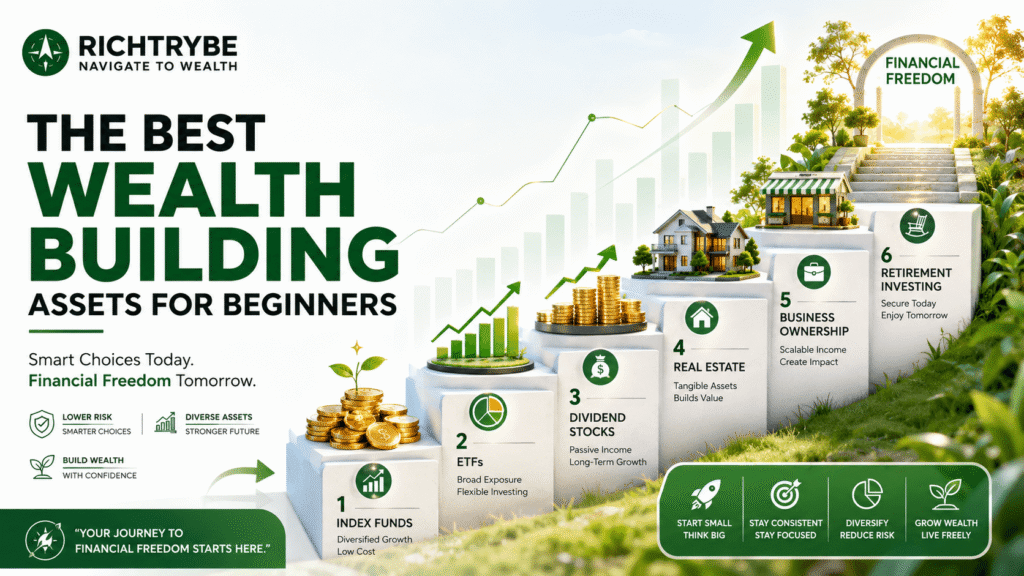
The best wealth building assets for beginners are investments that offer long-term growth, diversification, accessibility, and the ability to compound over time.
Common examples include:
- Broad-market index funds
- ETFs
- Retirement accounts
- Dividend-paying investments
- Real estate investments
- Business ownership
- Cash reserves for stability
The goal is not to own every asset available. The goal is to consistently acquire assets that build wealth over time and align with your financial goals.
Most successful investors start with a few simple assets and gradually expand their ownership as their knowledge, income, and net worth increase.
Why Asset Selection Matters
Not all assets contribute equally to wealth creation.
Some assets generate long-term growth. Others provide income. Some offer stability during uncertain economic conditions.
Choosing the right assets early can help beginners:
- Build wealth more efficiently
- Reduce investment risk
- Develop investing confidence
- Create multiple sources of financial growth
- Accelerate long-term net worth accumulation
This is why understanding wealth building assets for beginners is so important. The assets you acquire today can influence your financial future for decades.
As discussed in Why Assets Matter More Than Income: 7 Reasons Wealth Builders Focus on Ownership, ownership is often the true driver of long-term wealth.
The 7 Best Wealth Building Assets for Beginners
Not all assets contribute to wealth creation in the same way. Some assets are designed primarily for growth, while others provide income, stability, or diversification. The best approach for most beginners is not to search for a single “perfect” investment but to build a collection of assets that work together over time.
The most effective wealth building assets for beginners share several characteristics: they are accessible, relatively easy to understand, capable of long-term growth, and suitable for consistent investing.
By focusing on proven asset classes rather than speculation, investors can create a solid foundation for lasting wealth.
Asset 1: Broad-Market Index Funds
For many investors, index funds are the ideal starting point because they provide instant ownership in a large portion of the economy through a single investment.
Rather than attempting to identify individual companies that may outperform the market, index funds track an entire market index and allow investors to participate in the collective growth of hundreds or thousands of businesses simultaneously. This approach removes much of the guesswork associated with stock picking while still providing exposure to long-term economic growth.
What makes index funds particularly attractive as one of the best assets for beginner investors is their simplicity. Investors can gain broad diversification without constantly researching companies, monitoring earnings reports, or trying to predict market trends.
Key advantages include:
- Instant diversification
- Low management fees
- Reduced investment complexity
- Long-term growth potential
- Lower risk than concentrating investments in individual stocks
Historically, broad ownership of productive businesses has been one of the most reliable ways to build wealth. For beginners, index funds provide a straightforward path toward asset ownership while allowing compound growth to work over decades.
Asset 2: Exchange-Traded Funds (ETFs)
ETFs offer many of the same benefits as index funds while providing additional flexibility and customization.
An ETF can be purchased and sold like a stock, making it easy for investors to gain exposure to specific markets, sectors, or investment themes. Instead of buying dozens of individual securities, investors can access entire segments of the market through a single ETF.
ETFs can provide exposure to:
- Domestic stock markets
- International markets
- Bonds
- Dividend-focused investments
- Industry sectors
- Real estate sectors
One of the reasons ETFs remain popular among investors is their ability to combine diversification with flexibility. Investors can build a portfolio that reflects their goals while still maintaining broad market exposure.
For those seeking practical wealth building assets for beginners, ETFs provide a low-cost, accessible way to diversify investments without requiring significant capital or advanced investing knowledge.
Asset 3: Retirement Accounts
Retirement accounts are often overlooked because they are not a specific investment themselves. However, they are among the most powerful wealth-building tools available because they create an environment where assets can grow efficiently over long periods.
Retirement accounts encourage investors to think beyond short-term market fluctuations and focus on decades of growth. This long-term perspective is one of the biggest advantages successful investors possess.
These accounts often provide benefits such as:
- Tax advantages
- Automated investing opportunities
- Long-term investment discipline
- Reduced emotional decision-making
- Enhanced compound growth potential
The true power of retirement investing comes from consistency. Small contributions made regularly over many years can accumulate into substantial portfolios because investment gains remain invested and continue compounding.
This is why retirement accounts remain one of the most effective assets that build wealth over time, particularly for individuals who are just beginning their investing journey.
Asset 4: Dividend-Paying Investments
Some assets generate wealth in two ways: through appreciation and through income. Dividend-paying investments fall into this category.
Companies that pay dividends distribute a portion of their profits to shareholders. Investors receive these payments simply because they own the asset. Over time, dividends can create an additional stream of income while the underlying investment continues to grow in value.
Benefits include:
- Passive income generation
- Potential long-term appreciation
- Reinvestment opportunities
- Increased portfolio cash flow
- Enhanced compounding potential
One of the most powerful wealth-building strategies is dividend reinvestment. Instead of spending dividends, investors use them to purchase additional shares, increasing ownership and accelerating future income generation.
For investors seeking assets that build wealth over time, dividend-focused investments can play an important role in both growth and income generation.
Asset 5: Real Estate Investments
Real estate has created wealth for generations because it offers multiple avenues for financial growth.
Unlike many assets that rely solely on appreciation, real estate can generate income while simultaneously increasing in value. This combination makes it one of the most respected beginner wealth building strategies available.
Real estate can build wealth through:
- Property appreciation
- Rental income
- Inflation protection
- Portfolio diversification
- Leverage opportunities
While purchasing physical property may require substantial capital, beginners now have more accessible options. Real Estate Investment Trusts (REITs) and real estate-focused funds allow investors to gain exposure to property markets without directly owning buildings.
This accessibility makes real estate a practical addition to a diversified portfolio even for investors who are still learning how to build wealth.
Asset 6: Business Ownership
Business ownership remains one of the most powerful forms of asset ownership because it offers the potential for growth that is not directly tied to hours worked.
Unlike employment income, which is generally limited by time and effort, businesses can scale through systems, employees, technology, and market expansion. As a result, many of the world’s wealthiest individuals built their fortunes through business ownership.
Business ownership can include:
- Starting a business
- Purchasing an existing company
- Investing in private businesses
- Building online businesses
- Acquiring equity in growing ventures
The primary advantage is scalability. A successful business can increase its revenue, profitability, and overall value over time, creating both income and substantial asset growth.
While business ownership carries higher risk than some traditional investments, it remains one of the strongest assets that build wealth over time for individuals willing to develop the necessary skills and accept calculated risk.
Asset 7: Cash Reserves and High-Yield Savings
Cash is often excluded from conversations about wealth building because it generally produces lower returns than other assets. However, cash plays a critical supporting role in every successful portfolio.
Without adequate cash reserves, investors may be forced to sell long-term investments during emergencies, potentially locking in losses and disrupting wealth-building plans.
Strong cash reserves help investors:
- Handle unexpected expenses
- Avoid unnecessary debt
- Stay invested during market downturns
- Take advantage of investment opportunities
- Improve overall financial stability
High-yield savings accounts can provide modest returns while maintaining liquidity and accessibility.
Although cash alone rarely creates substantial wealth, it creates the stability necessary to continue acquiring other wealth building assets for beginners consistently. In that sense, cash functions as the foundation that supports long-term asset accumulation and financial growth.
As discussed in How to Turn Small Savings Into Wealth-Building Assets: 5 Proven Strategies for Long-Term Growth, financial stability often creates the foundation for successful investing.
How to Choose the Right Wealth-Building Assets
Choosing the best wealth building assets for beginners depends on your financial goals, risk tolerance, investment timeline, income level, and existing assets. While every investor’s situation is different, the most successful portfolios are usually built around a diversified mix of assets that can grow in value, generate income, or both.
For most people learning how to build wealth as a beginner, simplicity is often the best approach. Broad-market index funds, ETFs, retirement accounts, and cash reserves provide a strong foundation because they combine diversification, accessibility, and long-term growth potential.
The goal is not to find the perfect investment or own every asset available. The goal is to consistently acquire assets that build wealth over time, increase ownership, and strengthen your financial position year after year. As your experience and income grow, you can gradually expand into additional wealth-building opportunities.
The strongest wealth-building assets typically share three characteristics: appreciation, income generation, and compound growth.
Common Mistakes Beginners Make
Even when investors understand the best assets for beginner investors, many struggle because they focus on excitement rather than proven wealth-building principles.
- Chasing Fast Profits: Many beginners are attracted to investments that promise quick returns. While these opportunities can seem appealing, they often involve significant risk and can distract from proven beginner wealth building strategies focused on long-term ownership.
- Ignoring Diversification: One of the biggest mistakes when selecting wealth building assets for beginners is concentrating too much money in a single stock, sector, or investment. Diversification helps reduce risk and creates a more resilient portfolio capable of performing across different market conditions.
- Waiting Too Long to Start: Many people spend years researching investments without taking action. The reality is that time is one of the most powerful wealth-building tools available. Delaying the purchase of assets that build wealth over time can result in missed opportunities for appreciation and compound growth.
- Focusing on Market Timing: Attempting to predict short-term market movements is difficult, even for professional investors. Most successful investors focus on consistently acquiring quality assets rather than trying to perfectly time every market cycle.
- Neglecting Consistent Contributions: Building wealth is rarely the result of a single investment. The most effective beginner wealth building strategies involve regular contributions, disciplined investing, and allowing assets to grow over long periods. Consistency often has a greater impact on long-term results than finding the next winning investment.
As discussed in Why Most People Never Build Wealth, delayed action is often more damaging than imperfect action. The sooner you begin acquiring wealth building assets for beginners, the more time your investments have to grow and compound.
How Asset Ownership Changes Your Financial Future
Once you understand the best wealth building assets for beginners, financial decisions begin to change.
Instead of asking:
“How much can I earn?”
You begin asking:
“How much can I own?”
Over time:
- Asset ownership expands
- Investing becomes more consistent
- Net worth grows steadily
- Financial confidence improves
- Financial freedom becomes more achievable
As discussed in How to Build Long-Term Financial Stability, lasting wealth is rarely created by a single investment. It is usually the result of consistently acquiring quality assets and allowing them to grow over many years.
FAQs
What are the best wealth building assets for beginners?
Broad-market index funds, ETFs, retirement accounts, dividend-paying investments, real estate investments, and business ownership are among the most effective options.
What assets build wealth over time?
Assets that appreciate, generate income, or compound over long periods are typically the strongest wealth-building assets.
Are index funds good for beginners?
Yes. Index funds provide diversification, low costs, and long-term growth potential, making them ideal for beginner investors.
How much money do I need to start investing?
Many platforms allow investors to begin with small amounts through ETFs and fractional investing.
Why is diversification important?
Diversification helps reduce risk by spreading investments across multiple assets rather than relying on a single investment.
Final Thoughts
Understanding the best wealth building assets for beginners can dramatically improve your financial future.
You do not need a large amount of money to begin building wealth. What matters most is acquiring quality assets consistently and allowing time, appreciation, and compounding to work in your favor.
The sooner you begin building ownership, the sooner your assets can start contributing to long-term financial freedom.
If you’re ready for the next step, read The First Assets Every Beginner Should Focus On (Start Building Wealth Today) to learn which wealth-building assets deserve priority in the early stages of your financial journey.