When you are new to investing, the hardest question is rarely which assets exist — it is which ones to buy first. The first assets every beginner should focus on are not chosen for their excitement or their potential returns. They are chosen for their order. Acquiring assets in the right sequence protects your finances, builds momentum, and prevents the costly mistakes that derail most new investors before they ever benefit from compound growth.
This guide is about priority and sequence: what to secure before you invest a single dollar, what to acquire next, and how to know when you are ready to move up to the next rung. If you want the full catalog of options instead, read The Best Wealth Building Assets for Beginners, and for how to combine them into a single portfolio, see Build an Asset Portfolio From Scratch.
Quick Answer: The First Assets Every Beginner Should Focus On
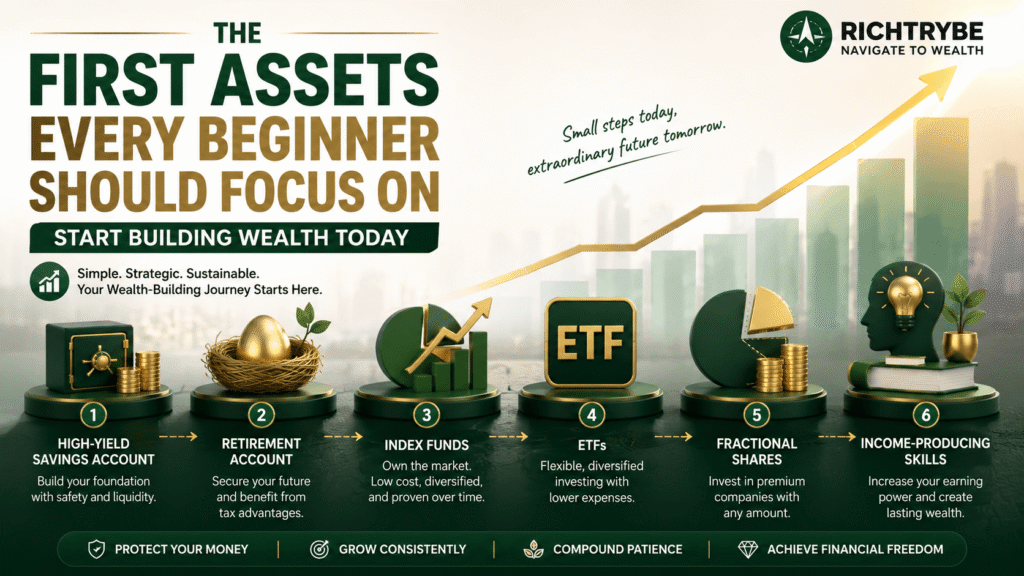
The first assets every beginner should focus on, in priority order, are: an emergency cash reserve in a high-yield savings account, a retirement account (capturing any employer match first), broad-market index funds, then international and ETF diversification, and finally income-producing skills that increase how much you can invest. Each rung is only worth climbing once the one below it is secure.
Why the Order Matters More Than the Asset
Two people can own the exact same investments and end up with completely different results — because one bought them in the wrong order. Someone who pours money into stocks before building any cash cushion is often forced to sell at the worst possible moment when an emergency hits. Someone who chases a speculative asset before capturing free employer-matched contributions leaves guaranteed money on the table.
Sequencing solves this. By acquiring foundational assets first, you create the stability that lets every later investment stay invested long enough to compound. This is why the first assets every beginner should focus on are arranged as a ladder, not a menu — each rung makes the next one safer.
The Priority Ladder: First Assets in Order
Rung 1: A Cash Reserve in a High-Yield Savings Account
Before any investing, your very first asset is accessible cash. An emergency fund of three to six months of essential expenses, held in a high-yield savings account, is what keeps a surprise bill from turning into high-interest debt or a forced sale of investments. The Consumer Financial Protection Bureau highlights emergency savings as a foundation of financial stability for exactly this reason.
Move to the next rung when: you have at least a starter emergency fund in place and your essential expenses are covered without relying on credit.
Rung 2: A Retirement Account (Capture the Match First)
Your next priority is a retirement account. If you have access to an employer plan that matches contributions, that match is the highest-return “asset” available to a beginner — an immediate return you cannot replicate anywhere else, so it comes before almost everything. Beyond the match, retirement accounts combine tax advantages with the long time horizon that makes compounding work.
Move to the next rung when: you are at least capturing your full employer match and contributing consistently.
Rung 3: Broad-Market Index Funds
Once your foundation is set, broad-market index funds are usually the first growth asset to acquire. A single index fund gives you ownership in hundreds or thousands of companies, providing instant diversification at low cost without requiring you to pick individual winners. For most beginners, this is where genuine wealth building begins.
Move to the next rung when: you are investing regularly into a low-cost broad index fund and understand what you own.
Rung 4: International Exposure and ETFs
With a domestic index fund in place, the next assets to add are international stock exposure and targeted ETFs. These broaden your diversification across regions and sectors, reducing reliance on any single market. They belong on rung four rather than rung one because they refine an already-working portfolio rather than replace its foundation.
Move to the next rung when: your core holdings are diversified across domestic and international markets.
Rung 5: Income-Producing Skills
The most overlooked of the first assets every beginner should focus on is your own earning power. Skills, certifications, and expertise increase how much income you can convert into assets. Early in your journey, a raise or a profitable side skill often moves your net worth faster than any market return, because it expands the fuel for every rung below.
As discussed in How to Transition From Income to Assets, increasing income expands your ability to acquire assets and accelerate net worth growth.
How to Know When to Climb to the Next Rung
The ladder is sequential, but it is not rigid. Most beginners can use a few simple signals to decide when to progress:
- The current rung is funded consistently, not occasionally
- An unexpected expense would not force you to undo it
- You understand what you own and why you own it
- Adding the next asset would not create stress about cash flow
When those are true, climbing is safe. When they are not, staying put and strengthening the current rung is the better move.
Common Sequencing Mistakes Beginners Make
- Investing before building any cash reserve: the most common error, and the one most likely to force a panicked sale during an emergency.
- Skipping the employer match: bypassing matched contributions to chase a flashier asset means turning down a guaranteed return.
- Jumping to advanced or speculative assets too early: individual stocks, crypto, and niche investments are not beginner starting points, no matter how exciting.
- Trying to climb every rung at once: spreading limited money too thin means none of the foundations are actually secure.
- Ignoring earning power: treating skills as separate from “investing” overlooks the asset that funds all the others.
As discussed in Why Most People Never Build Wealth, delayed or out-of-order action is often more damaging than imperfect action.
FAQs
What are the first assets every beginner should focus on?
In priority order: a cash reserve in a high-yield savings account, a retirement account (capturing any employer match first), broad-market index funds, international and ETF diversification, and income-producing skills.
What should I invest in first as a beginner?
Secure an emergency cash reserve first, then capture any employer retirement match, then begin investing in a low-cost broad-market index fund. Foundation before growth.
Why does the order of acquiring assets matter?
Acquiring foundational assets first creates the stability that lets later investments stay invested long enough to compound, and prevents forced selling during emergencies.
How do I know when to move to the next asset?
Move up when the current rung is funded consistently, an emergency would not undo it, you understand what you own, and adding the next asset would not strain your cash flow.
Should beginners buy individual stocks first?
Usually not. Individual stocks and speculative assets sit near the top of the ladder. Most beginners benefit from diversified index funds before picking single companies.
Final Thoughts
The first assets every beginner should focus on are powerful not because they are sophisticated, but because they are acquired in the right order. Build your cash foundation, capture free retirement matching, add broad index funds, diversify, and grow your earning power — one secure rung at a time.
Once you know the order, the next step is assembling these assets into a single structure. Read Build an Asset Portfolio From Scratch to turn this priority ladder into a working portfolio.