Knowing that assets build wealth is one thing. Actually converting a paycheck into a growing base of assets, month after month, is another. This guide is about the mechanics of that shift: a repeatable, four-stage process for how to transition from income to assets so that a steadily rising share of your money comes from what you own rather than the hours you work.
If you want the case for why ownership beats earning in the first place, read Why Assets Matter More Than Income. This article assumes you are convinced and focuses entirely on the how.
What It Means to Transition From Income to Assets
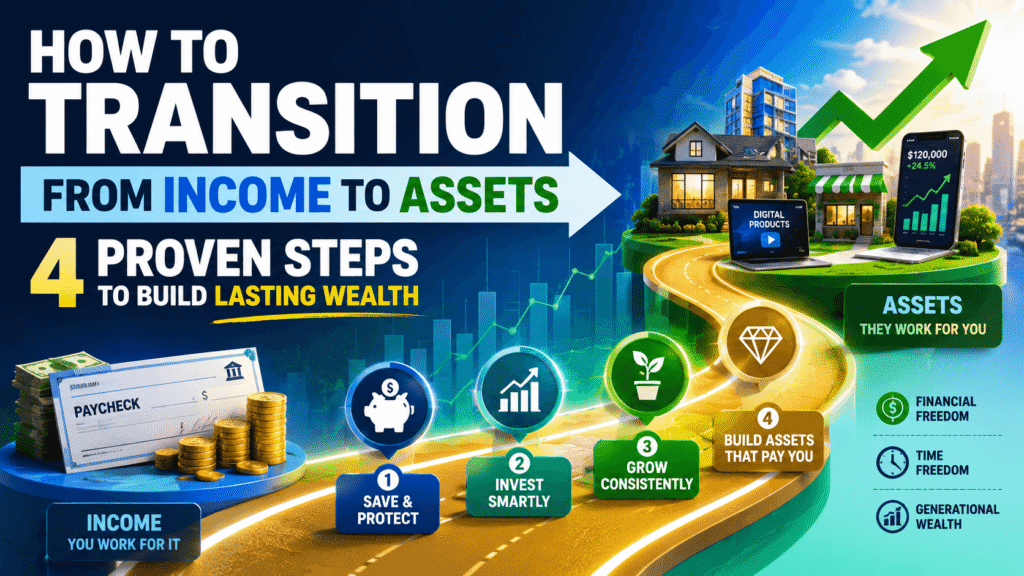
The transition from income to assets means deliberately routing a portion of every dollar you earn into investments and income-producing assets, instead of letting it all flow back out as spending. Income pays your bills; assets build your net worth. The transition is the system that connects the two — and it is what separates wealth builders from high earners whose net worth never moves.
Research backs this up. According to the Federal Reserve’s Survey of Consumer Finances, households that own investments, businesses, and other appreciating assets tend to accumulate substantially more wealth over time than those relying primarily on earned income.
Quick Answer: How to Transition From Income to Assets
The transition runs through four stages, in order: create a surplus you can invest, build a financial foundation that protects it, convert that surplus into wealth-producing assets, and reinvest the returns so your assets begin funding more assets. Each stage feeds the next.
The 4-Stage Process to Turn Income Into Assets
Stage 1: Create a Surplus to Invest
You can only buy assets with money you have not already spent. The first stage is engineering a reliable gap between what you earn and what you spend, because that gap is the raw material for everything that follows.
- Track where your money currently goes for one full month
- Cap lifestyle inflation when income rises — bank the raise instead of absorbing it
- Target a specific savings rate; many wealth builders aim for 15–20% of income and adjust over time
- Automate the surplus out of your checking account before you can spend it
The goal is not extreme frugality — it is a consistent, repeatable surplus you can deploy every month.
Stage 2: Build a Foundation That Protects Your Assets
Before investing aggressively, build a buffer so a single emergency cannot force you to sell investments at the worst possible time. A solid foundation usually includes three to six months of essential expenses in cash, manageable debt, and high-interest balances under control.
This stage is what makes the transition durable. Without it, the first setback undoes your progress; with it, your assets can stay invested long enough to compound.
Stage 3: Convert Surplus Into Wealth-Producing Assets
This is the heart of the transition. Each time money arrives — a paycheck, raise, bonus, or refund — ask one question before spending it: “Can this buy an asset instead of a liability?” The table below shows the choice in action.
| Income Source | Liability Choice | Asset Choice |
|---|---|---|
| Bonus | New phone | Index fund investment |
| Raise | Lifestyle upgrade | Dividend stocks |
| Tax refund | Luxury purchase | Emergency fund or ETF |
| Side income | Extra spending | Digital product or business |
For the specific assets to direct that money toward, see The Best Wealth Building Assets for Beginners, and for keeping liabilities from eating your surplus, read How to Build Assets Instead of Liabilities.
Stage 4: Let Assets Generate More Assets
The final stage is where the transition becomes self-sustaining. As your assets produce dividends, interest, rental income, or business profit, reinvest those returns rather than spending them. Reinvested earnings buy more assets, which produce more earnings — the compounding cycle that eventually lets ownership outpace your salary.
The endpoint is not simply earning more. It is reaching the point where a growing share of your income comes from your assets rather than your labor.
Mistakes That Stall the Transition
- Spending every raise: lifestyle inflation quietly absorbs the exact surplus that was meant to buy assets.
- Waiting until you “earn enough”: the transition is driven by consistency and time, not by a large income.
- Investing before building a buffer: skipping Stage 2 means the first emergency forces you to sell.
- Spending investment gains too early: doing so breaks the Stage 4 compounding cycle before it starts.
- Treating it as one-time: the transition is a monthly habit, not a single decision.
FAQs
What does it mean to transition from income to assets?
It means routing a portion of your earned income into investments and income-producing assets, so a growing share of your wealth comes from ownership rather than active work.
How do I start turning income into assets?
Begin by creating a consistent surplus between income and spending, build an emergency buffer, then automate that surplus into wealth-producing assets and reinvest the returns.
What percentage of my income should I convert into assets?
Many wealth builders aim to direct 15–20% or more of income toward assets consistently, adjusting up or down based on their goals and stage of life.
Can I transition from income to assets on a low income?
Yes. The transition depends more on consistency than on income level. Small, regular contributions invested over time can build significant assets.
When does the transition become self-sustaining?
It becomes self-sustaining in Stage 4, once your assets generate enough returns that reinvesting them funds further asset purchases without relying solely on new income.
Final Thoughts
Learning how to transition from income to assets is less about a single decision and more about installing a system: create a surplus, protect it, convert it into assets, and reinvest what those assets produce. Run that cycle consistently and your wealth gradually shifts from depending on your effort to depending on your ownership.
Next, read The Difference Between Income, Wealth, and Financial Freedom to see where this transition ultimately leads.