Two people can earn identical salaries and end up in completely different financial positions twenty years from now. The difference rarely comes down to income. It comes down to what each person did with it.
High earners who spend everything they make do not build wealth. People with average incomes who consistently acquire assets often do. This is why assets matter more than income when it comes to long-term financial success.
The seven reasons below explain exactly why ownership outpaces earnings, and what that means for the financial decisions you make today.
Before you begin, read How to Build Assets Instead of Liabilities: 5 Smart Wealth-Building Strategies to understand how asset ownership becomes the foundation of wealth creation.
Quick Answer: Why Assets Matter More Than Income
Assets matter more than income because income earns money, while assets keep, grow, and multiply money. High income can improve your lifestyle, but asset ownership is what builds long-term wealth, generates passive income, and creates financial freedom.
While income provides cash flow, assets can generate additional income, appreciate in value, and increase net worth over time. This is why income alone does not create wealth. Without asset ownership, even a high income can disappear through spending and lifestyle inflation.
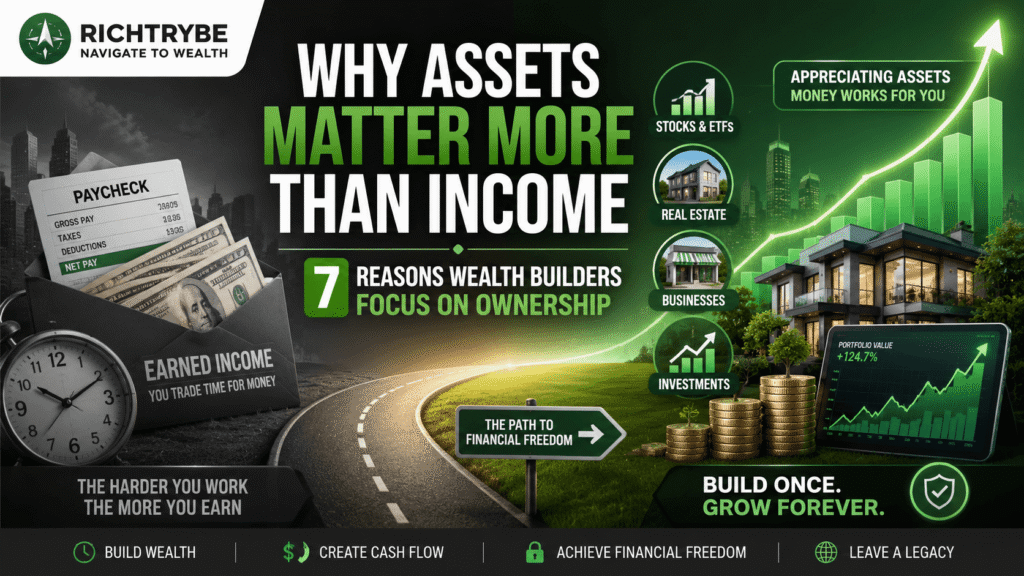
Examples of wealth-building assets include:
- Stocks
- ETFs
- Index funds
- Real estate
- Businesses
- Retirement accounts
The people who build lasting wealth focus on acquiring assets because assets continue working long after income has been earned.
7 Reasons Wealth Builders Focus on Ownership
- Assets increase net worth.
- Assets can generate passive income.
- Assets appreciate over time.
- Assets benefit from compound growth.
- Assets reduce dependence on earned income.
- Assets provide financial security.
- Assets make financial freedom achievable.
Assets vs Income: What Is the Difference?
To understand why assets matter more than income, it’s important to understand the difference between assets and income.
Income is money you earn from work, business activities, or investments. It provides cash flow and supports your lifestyle.
Assets, on the other hand, are things you own that can generate income, appreciate in value, or both.
| Factor | Income | Assets |
|---|---|---|
| Purpose | Provides cash flow | Builds net worth |
| Source | Work or business activity | Ownership |
| Growth Potential | Limited by time and effort | Can appreciate indefinitely |
| Income Generation | Active income | Passive or semi-passive income |
| Long-Term Wealth Impact | Creates opportunity | Creates wealth |
Income is important because it gives you the ability to acquire assets. However, wealth is typically measured by the assets you own rather than the income you earn.
This distinction is one reason many financially successful people focus more on ownership than earnings.
Why Income Alone Does Not Create Wealth
One of the biggest misconceptions in personal finance is that a higher income automatically leads to wealth.
In reality, income alone does not create wealth. If income were enough, every highly paid professional would become financially independent. Yet many high earners live paycheck to paycheck despite earning substantial salaries.
The reason is simple. Income only becomes wealth when it is converted into assets.
A person earning $50,000 annually while consistently investing may build greater wealth than someone earning $250,000 who spends nearly everything they make.
Many people follow a pattern like this:
- Income increases
- Spending increases
- Lifestyle expands
- Savings remain low
- Wealth growth stalls
This cycle explains why income and wealth are not the same thing.
As discussed in The Difference Between Income, Wealth, and Financial Freedom, income creates financial opportunities, but wealth comes from ownership.
Why Asset Ownership Matters
When discussing long-term wealth creation, one concept consistently stands out, why asset ownership matters.
Ownership allows you to participate in growth.
Instead of continuously exchanging time for money, asset ownership gives you access to appreciation, investment returns, and income streams that can continue generating value over time.
Consider what happens when you own:
- Stocks that increase in value
- Dividend-paying investments
- Rental properties
- Businesses
- Retirement portfolios
These assets can grow regardless of whether you’re actively working.
This is one of the most powerful advantages of ownership. Assets allow wealth creation to become increasingly independent of your daily effort.
How Assets Create Wealth
Understanding how assets create wealth is essential because wealth is not built by what you earn, it is built by what you own.
Unlike income, which typically requires continuous effort, assets can continue creating value long after they are acquired. This is why wealthy individuals focus on accumulating assets rather than relying solely on higher earnings.
Assets create wealth through three powerful mechanisms:
1. Appreciation
Many assets increase in value over time, allowing your net worth to grow without requiring additional work or income.
Examples include:
- Stocks
- Index funds
- ETFs
- Real estate
- Businesses
As these assets appreciate, the value of what you own increases. This means wealth can grow even if your income remains unchanged. Over the long term, appreciation often becomes one of the largest contributors to net worth growth.
2. Income Generation
Some assets do more than increase in value, they also produce income while you own them.
Examples include:
- Dividend-paying stocks
- Rental properties
- Businesses
- Interest-bearing investments
This creates a powerful advantage. Instead of relying entirely on your paycheck, your assets begin generating additional cash flow that can be spent, saved, or reinvested into acquiring even more assets.
Over time, this creates multiple streams of income and reduces dependence on earned income alone.
3. Compound Growth
Compounding is where wealth creation begins to accelerate.
When assets generate returns and those returns remain invested, future growth is earned on both the original investment and previous gains. In other words, your money starts earning money, and eventually, those earnings start earning money too.
Compounding works through a simple cycle:
- Assets generate returns
- Returns remain invested
- Future returns are earned on a larger base
- Growth accelerates over time
This is why the most successful investors often prioritize time and consistency over trying to find the perfect investment. The longer quality assets remain invested, the more powerful compounding becomes.
As discussed in The Wealth Building Formula Explained: 5 Steps to Build Long-Term Wealth, appreciation, income generation, and compound growth work together to transform simple asset ownership into long-term wealth creation.
The Importance of Assets in Building Financial Freedom
The importance of assets becomes even clearer when viewed through the lens of financial freedom.
Most people depend primarily on earned income.
This creates a challenge.
If income stops, financial progress often stops as well.
Assets provide an alternative.
As assets grow, they can begin generating income that supplements or partially replaces employment income.
Over time, this creates:
- Greater financial security
- Increased flexibility
- More financial options
- Reduced dependence on a paycheck
- Faster net worth growth
This is why financially independent individuals often focus heavily on building and maintaining assets.
Assets provide freedom because they reduce reliance on active work.
Why Wealthy People Prioritize Assets
One reason wealthy individuals continue building wealth is that they understand the difference between earning and owning.
Many people focus on increasing income.
Wealthy individuals focus on increasing ownership.
When additional money becomes available, they often direct it toward:
- Investments
- Businesses
- Real estate
- Retirement accounts
- Other appreciating assets
This behavior creates a powerful cycle.
More assets lead to more growth.
More growth creates additional opportunities to acquire assets.
Over time, wealth begins compounding on itself.
As discussed in Why Most People Never Build Wealth, one of the biggest financial mistakes is using increased income primarily for consumption rather than ownership.
How to Make Assets a Priority
Understanding why assets matter more than income is important, but wealth is built through action, not awareness. The key is to make asset acquisition a regular part of your financial life rather than something you do only when extra money is available.
This shift from focusing on assets vs income is often what separates wealth builders from high earners who never accumulate significant net worth.
Here are practical ways to prioritize asset ownership:
1. Pay Yourself First
Before spending on lifestyle upgrades or discretionary purchases, set aside a portion of your income for investing. This ensures that building wealth becomes a priority rather than an afterthought.
2. Invest Consistently
Successful investors don’t wait for perfect market conditions. They invest regularly and allow time and compound growth to work in their favor. Consistency often has a greater impact on long-term results than timing.
3. Increase Asset Purchases
Whenever your income increases, direct part of that additional money toward acquiring assets. Stocks, ETFs, index funds, businesses, and real estate can all contribute to long-term net worth growth and are essential for building wealth through assets.
4. Limit High-Cost Liabilities
The more income consumed by debt payments and depreciating purchases, the less money remains available for investing. Keeping unnecessary liabilities under control creates more room for asset accumulation.
5. Reinvest Returns
One of the fastest ways to accelerate wealth creation is to reinvest dividends, interest, rental income, and investment gains. This allows your assets to purchase additional assets, creating a powerful compounding effect over time.
These habits may seem simple, but they represent the difference between merely earning income and building lasting wealth. The goal is to gradually shift more of your income toward ownership, allowing your assets to become an increasingly important driver of financial growth.
Common Signs You’re Focusing Too Much on Income
Many people spend years trying to increase their income without realizing that higher earnings alone rarely lead to financial freedom. One of the clearest signs that you’re prioritizing income over wealth is when your earnings grow but your net worth doesn’t.
Common warning signs include:
- Income increases but net worth remains stagnant: More money is coming in, but little is being converted into assets.
- Spending rises with every pay raise: Lifestyle inflation absorbs income that could have been invested.
- Little or no investing takes place: Most income is spent rather than used for building wealth through assets.
- Financial goals focus mainly on earning more: Attention is placed on income growth while asset ownership receives little focus.
- Asset ownership remains limited: Years of earning may pass without accumulating meaningful wealth-building assets.
- Most income is tied to active work: If your cash flow stops when you stop working, you may have an income problem disguised as a wealth problem.
These patterns highlight an important distinction in the assets vs income debate. Income creates opportunity, but assets create long-term wealth.
If these warning signs sound familiar, it may be time to shift your focus from simply earning more to acquiring more. The goal isn’t to earn less, it’s to ensure your income is consistently converted into assets that grow your net worth, generate future income, and support long-term financial freedom.
As discussed in How to Transition From Income to Assets, the people who build lasting wealth understand that income alone does not create wealth. Wealth is built when income is transformed into ownership.
The Long-Term Impact of Asset Ownership
When you prioritize asset ownership, your finances begin to improve in ways that income alone cannot:
- Net Worth Grows: Assets increase in value and add to your overall wealth.
- Passive Income Expands: Investments can generate income without requiring additional work.
- Financial Security Improves: A growing asset base provides protection against financial setbacks.
- Dependence on Employment Decreases: More of your wealth comes from what you own, not just what you earn.
- Financial Freedom Becomes More Achievable: Assets create flexibility, options, and long-term stability.
This is the importance of assets in wealth building. Over time, assets can generate growth and income on their own, which is why income alone does not create wealth.
The people who build lasting wealth focus on increasing ownership because that is ultimately how assets create wealth.
How Understanding Assets Changes Your Financial Future
Once you understand why assets matter more than income, your financial focus begins to shift. Instead of asking, “How much can I earn?” you start asking, “How much can I own?”
That mindset change can have a significant impact over time:
- Asset Ownership Becomes a Priority: More income is directed toward wealth-building assets.
- Investing Becomes More Consistent: Regular investing replaces sporadic financial decisions.
- Net Worth Grows Faster: Assets accumulate and compound over time.
- Financial Independence Becomes More Attainable: You rely less on earned income and more on what you own.
- Wealth Creation Becomes More Predictable: Long-term ownership replaces short-term financial guesswork.
As discussed in How to Build Long-Term Financial Stability, lasting wealth is rarely created by a single decision. It is usually the result of consistently acquiring assets and allowing them to grow over many years.
FAQs
Why do assets matter more than income?
Assets matter more than income because they can generate income, appreciate in value, and increase net worth long after income has been earned.
Can a high income make you wealthy?
A high income can help, but income alone does not create wealth. Wealth is usually built by converting income into assets.
Why is asset ownership important?
Asset ownership allows individuals to participate in appreciation, investment returns, and passive income generation.
What are examples of wealth-building assets?
Examples include stocks, ETFs, index funds, real estate, businesses, and retirement accounts.
How do assets create wealth?
Assets create wealth through appreciation, income generation, and compound growth.
Is income still important?
Yes. Income provides the resources needed to acquire assets. However, assets are typically what transform income into long-term wealth.
Final Thoughts
Understanding why assets matter more than income is one of the most important lessons in wealth building.
Income creates opportunity, but ownership creates wealth.
The individuals who achieve financial freedom are rarely those who simply earn the most money. More often, they are the people who consistently acquire assets, reinvest returns, and allow time and compound growth to work in their favor.
The biggest financial shift isn’t moving from a low income to a high income, it’s moving from relying on income to owning assets. Income can fund your lifestyle, but assets can fund your future. The sooner you prioritize ownership, the sooner wealth begins working for you instead of requiring constant work from you.